Week 1 to Week 4 Activities – Settlement Time

Free Play - Play out in the premises.

Total Time 30 Min.

Circle Time: Prayer, Shloka chanting, Welcome song, Conversation(15 Min).
Hello how are you (4)(Hello Song for Kids by Sing with Bella)

How are you today.
I am good, I am great, I am wonderful.
Hello how are you (4)
How are you today.
Can you clap your hands (4)?
Clap your hands with me.
Can you touch your nose (4)?
Touch your nose with me.
OOOIIIEEE

Rhyme Time:(10 min)
Lunch Time: (25 Min)
Action Song and Movement:(10 min)
If you are happy and you know it…….

Select 4 to 5 actions from below. Repeat actions chosen for 3 days

Clap your hands, Clap your knees, Close your eyes, Cross your arms/legs, Dance, Freeze, Jump, Laugh, Make a funny face, Move forward/back one step, Move like a robot, Open your mouth, Play the air guitar, Put your hands on your hips, Put your hands on your shoulders, Put your hands on your stomach, Put your thumbs up, Shake your body, Shake your head, Snap your fingers, Stamp your feet, Stick your tongue out, Stand on your toes, Swim, Touch your elbows, Touch your mouth, Touch your nose, Touch your toes, Turn around, Walk on your spot, Turn around, Wave goodbye, Wriggle your fingers

Free Choice Activity Time: 20 Min

Out of 20 activities given, teachers set up 5 activities for a week, and then change them in the next week.

1. Make a facein the outline given using material given.

2. Sticker Line-Up

Material: Big Dot Stickers, Chart Paper
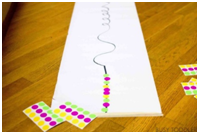

Procedure:

  • Roll out a chart paper for 4 toddlers.
  • Draw a mix of zig-zag, curly, loopy, and swirly lines down the center of the paper.
  • Toddlers use dot/bindi stickers to “trace” the line.
  • Toddlers peel the stickers from their sheet and line them up on the paper.
  • Some Toddlersaren’t quite ready for activities like this so set up with a plain piece of paper and a sheet of stickers for their own play.
3. Sort and Drop

Material: Chart Paper, Packing Tape, Box, Knife, Scotch Tape, Colored Sketch Pens and Colored Blocks.

Procedure:

  • Cover the box top with chart paper and tape the paper in place.
  • Then cut five squares into the top of the box and tape the edges around squares so that they wouldn’t rip.
  • Lastly, outline each square with a different color – red, yellow, green, blue, orange.
  • Have both small and large blocks, since they are easierto manipulate.
  • Let Toddlers dropthe blocks into the colored squares while they sort and drop them.
  • Talk about the shapes and sizes of each one.
  • Some blocks would be bigger than others so let Toddlersturn them or twist them so that they could fit in the right hole.
4. Fine Motor Color Sorting Activity

Material: Pom poms, Tweezers, Divided Tray

Procedure:

  • Place four different colored of pom poms in the center of the tray along with the tweezers.
  • Since the tweezers are shaped like an alligator, make this activity into a “Feed the ‘Gator Game”.
  • Tell that the alligator doesn’t like his food all mixed up and he needed help sorting it out by color. Todd Hunterswill be more than happy to help the alligator.
  • Extension idea: Use the setup, assigning a specific color to each student. Use dice to decide how many pom poms to grab.
  • The teacher sits and plays the game with them while reinforcing color vocabulary, some kids are familiar with colors, but this is still a great fine motor activity.
5. Matching Objects Puzzle

Material: Markers, Colored Cards, Scissors or Paper Cutter, Toys/Objects From Around The Class.

Procedure:

  • Cut 8 pieces ofcolor cards.
  • Trace some objects onto the card using a marker.
  • Lay out the completed “puzzles” and let Toddlers try and match the objects with the outline of each object you have traced.
  • If Toddlers struggle the first time, model how to complete the puzzles and then have them try again.
  • When finished, store the objects and cards in a basket so that they can try out puzzles again and again when they are playing.
6. Memory Game

Procedure:

  • Matching Objects Puzzles could also be modified to make it into a memory game. Just trace each object twice and letToddlers match the cards and clip them together with a clothespin.
  • The teacher fosters a lot of conversation about size, shape, and colors (ex. “the hammer is orange and yellow” or “the green cap is round”).
  • The teacher can also talk about the function of the objects.
  • The teacher can practice receptive language skills by asking Toddlersto listen and follow directions, for example, “find the object that is red and round” or “find the object that you use to hammer a nail.”

The teacher can make the questions/directions easier or harder

7. Card Slot Drop

Material: Container, Deck of Cards, Utility Knife

Procedure:

  • Carefully cut a hole in the top of the cardboard container – just wide enough for the cards to fit through.
  • Keep out a set of playing cards and let Toddlers figure out how to slide them into the card slot.
8. Shapes and Colors Activity Hunt

Material: Shape Blocks, Bowl/Tray, Rice/Mixed Cereals

Procedure:

  • Toddler can’t grasp shapes by looking at it on paper.
  • They want something that is in a hands-on way. Let them feel the shape, feel the curvesand feel the pointed edges. Kids learn very well through sensory experiences so set out on a way to fuse their mind’s understanding through their hands and sense of touch.
  • Create a Shapes Hunt.
9. Whisking bubbles

Material: Big Container, Whisks, Liquid Dish Soap, Optional – Food Coloring, Optional Scented Oils.
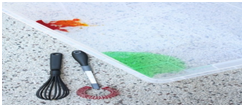
Procedure:

  • Food coloring and scent can be used because the water turns colored and the smell is nice, but whisking bubbles is enough.
  • Fill about a spoonful of dishwashing liquid soap, then fill the plastic container up with water.
  • Try and find a container that is wide, so the child can whisk well, a small space or bucket will restrict this whisking fun and frenzy
  • Bubbles need to be made with hard work and whisking.
  • Whisking and whisking and whisking eventually produces bubbles right up to the top.
10. Stacking Cups

Material: 8 stacks of big disposable cups.

Procedure:

  • The idea behind Speed Stacking is that children are learning how to sequence, finding patterns and the best way to stack a pyramid. The activity helps build the skills of perseverance and concentration.
  • Let Toddlersstart to create another stack of cups. They move each cup separately to another pile until they are all stacked.
  • Once that pile is complete let them take the top cup off and placed it on the floor/mat. They may then find great pleasure in knocking over the cups one at a time.
  • Once each cup has been knocked over,they may make a new pile of cups and then transfer them again from one pile to another and back again.
  • They may then place individual cups in a circle around them. The stacking activity can be varied depending on the Toddlers wish.
11. Recycled Building STEM Activity – Little Toddler City.

Material: One man’s junk is another toddler’s building supplies.

Procedure:

  • A toddler would much rather play with random junk than actual toys. 
  • This activity helps in the engineering and problem solving they have to do to make their buildings.
  • Non-standard materials like this invite so much creativity and needs so much extra thought to actually work. It is fantastic to watch little brains tackling this.
  • Theymay build bridges, roads, tunnels and tall towers. They will really likethat with these big materials, they can make some seriously tall buildings.
  • Let Toddlers roll or move toy vehicles, other pretend play material over and under the buildup structures.
12. Pom Pom Racing

Materials: Pom Poms, A slightly shorter straw (cut on in half)

Procedure:

    • Set up a race track with a start and finish line, not too far from each other.
    • Place pom poms on the start line, each with their own blowing straw.
    • Let Toddlers blow through the shorter straw to move the pom poms ahead, to reach the finish line
    • After a few rounds of this activity, set box goals at the other end.
    • Now no more random blowing.It is a little harder than it looks to get the pom poms into the box.
    • Use four to five boxes and stick them to the floor with masking tape.
13. Pom Pom Push

Materials: Pom Poms, Empty plastic container

Procedure:

Take an old plastic container with a cover. With scissors poke a few holes in the top of the cover so that they were just big enough to fit and push through a pom poms ball.

14. Little Musicians

Materials: Take out all kinds of pots, Containers, and bowls and create an impromptu drum circle for the budding musicians. Sticks, wooden spoons, A Xylophone, and Background music are also added.

Procedure:

  • Let the Toddlers create and explore their own musical sounds.
15. What’s Missing.

Material: Tray, Items that toddler can name

Procedure:

  • Set up three to four items on a tray. Each item is something toddler is familiar with and has a word for. 
  • Set out the objects, making sure also to pick different colored items
  • Point to the objects and slowly say their names.
  • Do this twice before asking toddlers. Then ask them to say with you.
  • Then ask them to close eyes (this is a skill in and of itself) and cover one object with a cup.
  • Then I ask “What’s Missing?”
  • Toddlers may or may not give the correct answer in the beginning, its fine. Let some kids try the activity amongst themselves.
16. Treasure Hunt – Sensory Play

Material: Use something different as treasure…plastic gems, Tiny toys, play money, etc.

Procedure:

  • Hid the treasure with the plain rice (sand, flour, dry pasta, beans, and cereals would all be good alternatives).
  • Let the Toddlers hunt out the treasure and put them in a container/jar/ piggy bank box.
17. Water Pouring Stations

Material: A big storage tub, containers of different size and shapes, water, food coloring

Procedure:

  • Toddler activities don’t need to be fancy.They don’t need expensive suppliesor crazy long

set ups.

  • They just need simple and engaging play – and this activity gives them exactly that.
  • Grab various containers from around to pour and dump from.
  • Choose to make some of the water colored – this is optional.
  • Let the Toddlers explore by pouring and filling all by themselves.
18. Sink or Float Discovery Station

Material: a big and deep tub,water,food coloring, small objects with different densities – metal tools, coins, hair clips, pins, utensils, and plastic toys/ blocks/ cards etc.


Procedure:

  • Water is the simplest sensory material ever.
  • Fill the plastic tubwith some water and add a couple of drops of food coloring.
  • Neatly set the objects out on a tray and place it near the water tub.
  • Explain that when placed in the water, some of the items would sink and others would float, and thisis enough.
  • Show how to carefully drop in object after object, giving the time to marvel at the outcome each object brings.
  • Let Toddlers to play and then step back to watch activities unfold.
  • Let them predict whether or not the objects would float before putting them in the water.
  • Toddlers may put the objects back on the tray, and begin again.  
  • This time around, encourage them to try placing the objects on the water’s surface very gently.
  • While some objects that sunk the first time around after being dropped in sideways, when set in gently, they would float.
19. Scooping and pouringHide the Animals: Quick Sensory Bin

Materials: Small animals, Sand/Rice/Cereals, Storage containers/Box, A tray with 6 to 8 partitions, Scoop

Procedure:

  • Take tiny plastic animals and put one in each hole in the tray with partitions.
  • Keep it in a largestorage tub and keep the rice/cereals/sand in a smaller container next to the tray.
  • In the rice container, put a single scoop.
  • The goal: hide and bury the tiny animals in rice.
  • Each time they bury an animal, say, “What’s hiding?”
  • Let them immediately uncover the once buried animal.
20 Sticky Leaf Tree
  • Hunt and find all sorts of leaves. Draw the outline of a tree onto a long piece of chart paper. Spread some glue on it.
  • Invite the little ones to create their tree with the leaves you found.
  • Let Toddlers stick leaves on it then use tape to fasten it to the wall.

Home Time: Toddlers go to washroom, Get tidy before going home. (15 Min)